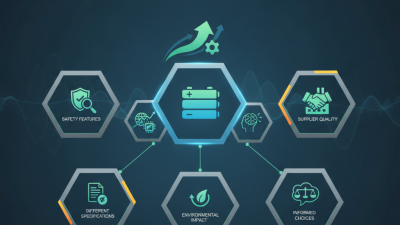
Choosing the right Li Ion Polymer Battery supplier affects safety, product life, delivery stability, and customer trust. A low price may look attractive, but it can hide weak quality controls, unclear cell origins, or inconsistent capacity. The best decision begins with evidence, not promises.
Battery scientist M. Stanley Whittingham has emphasized, “We need batteries that are safe, cheap, and have a high energy density.” This principle remains practical for modern product development. A reliable supplier should provide clear datasheets, capacity test results, safety certifications, and traceable production records. Ask how cells are graded. Ask how aging is monitored. Request samples from different production batches.
Details matter. Examine the protection circuit, connector quality, insulation, and swelling resistance. Confirm whether the battery matches your device’s charging current, operating temperature, and available space. Verify transport documentation, including applicable UN 38.3 testing. A supplier should also explain its quality system, complaint process, warranty terms, and replacement procedure.
A polished website proves little.
Look for experience with your application, not only a long product list. Medical equipment, wearable devices, GPS trackers, and industrial tools require different design choices. Technical communication matters too. Slow answers may signal future delays. However, even careful evaluations have limits. A factory audit cannot predict every shipment problem. Sample performance may not represent long-term production. That uncertainty deserves honest discussion.
The strongest Li Ion Polymer Battery supplier offers engineering support, consistent records, realistic lead times, and transparent limitations. Compare facts across several suppliers. Then choose the partner that protects both performance and responsibility.

A reliable battery project starts with a precise requirement sheet. Record the device’s voltage, capacity, peak current, and expected runtime. Include the available space, connector position, and maximum battery weight. A battery that fits electrically may still fail inside the enclosure.
Describe the working environment clearly. Note charging temperature, discharge temperature, humidity, vibration, and storage time. Define the expected cycle life and acceptable capacity loss. Ask for protection requirements, such as overcharge, over-discharge, short-circuit, and temperature control. Request test data, material traceability, and relevant safety documentation. From practical development work, vague requirements often create expensive redesigns. I have also seen teams overestimate capacity before testing real load patterns. That assumption deserves review.
Tips: Build a simple load profile using actual current readings. Request samples before final approval. Check dimensions with a physical mock-up, not only a drawing. Ask the supplier how capacity changes after repeated cycles. Confirm production consistency through inspection records and sample reports. Do not select a battery from capacity alone. A lower-capacity cell with stable output may perform better in the finished device. Keep one requirement flexible, if possible. Early prototypes can reveal that a preferred shape, connector, or charging rate needs adjustment. Clear specifications help suppliers provide safer, more accurate proposals.
How to Choose the Best Li Ion Polymer Battery Supplier
A dependable supplier should treat safety as a daily process, not a certificate on a wall. Ask for test records covering overcharge, short circuit, vibration, impact, and thermal abuse. The battery management system should control charging, discharge, and temperature limits. Request evidence that production cells match approved samples. Small differences in swelling, wire placement, or connector quality can create serious field problems.
Check relevant certifications and transport documentation, including IEC 62133-2, UN 38.3, and an active ISO 9001 quality system where applicable. Do not accept scanned certificates without verification. Confirm the issuing body, product model, test date, and certificate scope. A capable supplier should provide traceability from raw materials to finished packs. Factory audits, incoming inspection records, and batch-level testing reveal more than sales promises. In practice, documentation is sometimes incomplete. That is a warning, not a minor inconvenience.
Tips: Order samples before signing a large contract. Test capacity, cycle life, charging temperature, and physical dimensions under your real operating conditions. Inspect several units, not just one. Ask how rejected cells are isolated and recorded. Also review their response plan for swelling, overheating, or unexpected capacity loss. Clear answers matter. A supplier that welcomes technical questions usually supports more reliable cooperation. Still, keep your own test records; trusting supplier data alone can be an avoidable mistake.
Evaluate supplier safety, quality, and certification standards using a weighted assessment framework.
The recommended weighting prioritizes safety and quality evidence. Verify applicable transport testing under UN 38.3, cell and battery safety testing under IEC 62133-2 or UL 1642, quality-system certification such as ISO 9001, documented traceability, and supplier validation or technical support before making a purchasing decision.
Choosing the best Li-ion polymer battery supplier requires more than comparing prices. Battery design must match the device’s real operating conditions. Check cell dimensions, connector placement, protection circuitry, and available installation space. A battery that fits on paper may fail when cables bend or heat builds inside the enclosure.
Request drawings with tolerances, sample units, and test reports. Experienced suppliers should explain how they manage swelling, vibration, overcharge protection, and thermal limits. Their reports should identify test conditions, including discharge rate, temperature, and cycle count. Generic capacity figures can be misleading without this context.
Performance data needs careful review. Compare usable capacity, voltage stability, charging time, internal resistance, and expected cycle life. Ask whether testing reflects your product’s workload, not only laboratory conditions. Customization may include shape, capacity, wire length, connectors, labels, and battery management settings. Confirm minimum order quantities, tooling fees, sampling schedules, and production traceability before approval.
A reliable supplier welcomes technical questions and records design changes clearly. Still, no supplier can remove every risk. Early samples may expose weak connectors, unexpected heating, or limited runtime. Treat these findings as useful evidence, not failure. Pilot testing under cold, warm, idle, and peak-load conditions will reveal more than a polished datasheet.
Choosing a lithium-ion polymer battery supplier starts with real production capacity, not a polished presentation. The IEA’s Global EV Outlook 2024 reports that global battery manufacturing capacity exceeded 2.6 TWh in 2023, while demand was much lower. This gap can hide unused lines, limited polymer-cell experience, or weak quality controls. Ask for monthly output by cell model, line utilization, expansion plans, and recent delivery records. Nameplate capacity is not shipment capacity.
Testing processes reveal operational maturity. Request documented checks for electrode coating, moisture control, welding strength, capacity, internal resistance, swelling, and cycle life. A reliable supplier should also support IEC 62133-2 testing and UN 38.3 transport requirements. Test data must connect to lot numbers, operators, equipment, and calibration records. The IEA also notes that battery supply chains remain geographically concentrated, increasing disruption risks. Inspect backup production sites, critical-material sourcing, safety stock, and recovery procedures. Ask for evidence.
Do not trust one successful sample. Require pilot batches and independent validation. Track defect rates, on-time delivery, lead-time variation, and corrective-action speed for several quarters. Benchmark Mineral Intelligence’s 2024 battery manufacturing assessments distinguish announced capacity from operating capacity, a useful warning for procurement teams. A perfect supplier audit is rare. I have seen strong samples fail during scale-up. That weakness matters. Select the supplier that explains failures clearly, reports limitations early, and improves its process with measurable evidence.
How to Choose the Best Li Ion Polymer Battery Supplier
Price should be judged beyond the first quotation. BloombergNEF’s 2024 Battery Price Survey reported an average lithium-ion pack price of $115 per kWh. Prices fell 20% year over year. However, cell chemistry, minimum order quantity, testing, tooling, and shipping can change the final cost. Ask suppliers for a landed-cost breakdown. Include warranty replacements and safety testing. A low quote can hide expensive delays.
Support quality becomes visible during sampling and production changes. The IEA’s Global EV Outlook 2024 reported more than 750 GWh of EV battery demand in 2023, up about 40% from 2022. Fast-growing demand can stretch technical teams and delivery schedules. Request a named engineer, response-time targets, failure-analysis procedures, and clear escalation rules. Test their support before signing. Send a difficult technical question. The reply often reveals more than a polished presentation.
Long-term fit requires evidence, not promises. Review capacity plans, quality records, audit results, and traceability from cell batch to shipment. Ask how the supplier handles material shortages, design revisions, and end-of-life changes. A quarterly business review can expose problems early. No scorecard is perfect. I would weight quality consistency and communication above a small unit-price advantage. The best partner should share realistic lead times, admit limitations, and improve after a failed sample. Supplier stability matters because one missed production window can cost more than years of modest price savings.