Choosing a Hailong Ebike Battery requires more than matching voltage and appearance. Global buyers must assess compatibility, safety, capacity, shipping conditions, and after-sales support. The wrong choice may fit the frame but fail under daily riding demands.
Fit comes first. That sounds simple. Measure the battery cradle, rail spacing, connector, and mounting points before ordering. Then compare the motor’s rated voltage with the battery’s voltage. A 48V system generally needs a compatible 48V battery, not a guess based on the plug shape. Check capacity in amp-hours, but remember that range depends on rider weight, terrain, temperature, tire pressure, and assist level. A larger number is not always the better choice.
Look for clear cells, charger specifications, protection features, and traceable quality information. Ask the seller for product photos, test documents, warranty terms, and replacement-part policies. These details matter when the battery crosses borders. Packaging should protect terminals from impact and moisture. Import requirements and transport rules also vary by destination, so buyers should verify current local guidance before payment.
A polished label proves little. Real reliability appears in consistent specifications and responsive support. I have seen buyers focus on capacity while overlooking connector polarity or cradle alignment. That mistake is expensive. This guide compares practical selection points for the Hailong Ebike Battery, while acknowledging one limitation: published data may not reflect every production batch. Careful verification remains essential. A safe purchase begins with evidence, not optimism.
Define your riding needs before comparing battery labels. A daily city commute may need a smaller battery than a weekend route with steep climbs. Record your distance, rider weight, cargo, road surface, and typical weather. A 500Wh battery can feel adequate on flat roads, yet insufficient on hills or in strong wind. Cold temperatures also reduce usable range.
Match battery capacity with motor demand and riding habits. Voltage must suit the bicycle’s controller and motor system. Capacity, measured in ampere-hours, affects stored energy.
Watt-hours provide a clearer comparison: voltage multiplied by ampere-hours. For example, a 48V, 15Ah battery stores about 720Wh. Do not judge range from capacity alone. Tire pressure, assist level, stop frequency, and payload matter greatly.
Do not judge range from capacity alone. Tire pressure, assist level, stop frequency, and payload matter greatly.
Real riding experience often challenges optimistic estimates. I once expected a large battery to cover two long commuting days, but hills and frequent acceleration reduced the range sharply. That estimate was too optimistic.
Leave a practical reserve, often 20% or more, instead of planning to arrive with an empty battery. Check the charger’s input requirements, connector type, enclosure fit, water resistance, and verified safety documentation. A reliable supplier should provide test records, operating limits, storage guidance, and clear warranty terms. Small details matter.
How to Choose a Hailong Ebike Battery for Global Buyers
Match the battery voltage to your ebike system before comparing prices. A 36V motor usually needs a 36V battery, while a 48V system requires compatible voltage and charging limits. A higher voltage is not automatically better. It can damage the controller or create unsafe operating conditions. Check the motor, controller, display, and charger labels together. A practical fitting test also matters. The battery should lock firmly into the rail without movement or forced alignment.
Capacity affects riding distance. A 36V 15Ah battery stores about 540 watt-hours. A 48V 15Ah battery stores about 720 watt-hours. Actual range changes with rider weight, hills, tire pressure, wind, temperature, and riding speed. On a flat road, moderate assistance may produce a useful estimate. Heavy cargo can reduce it sharply. Advertised range can disappoint. I would rather plan with a 20% buffer than trust the highest figure.
Look for a battery with a suitable battery management system, clear cell information, and a protected enclosure. Confirm connector type, mounting dimensions, discharge current, and charger compatibility. Regional buyers should also check transport rules and required electrical certifications. Ask for test records, production dates, warranty terms, and replacement support. These details reveal reliability better than a polished product photograph. My own selection process is not perfect; specifications can be incomplete, and real-world testing remains essential. Test carefully.
Electric two-wheelers are becoming a major transport category. The International Energy Agency’s Global EV Outlook 2024 reports that over 10 million electric two- and three-wheelers were sold worldwide in 2023. For buyers, compatibility matters more than appearance.
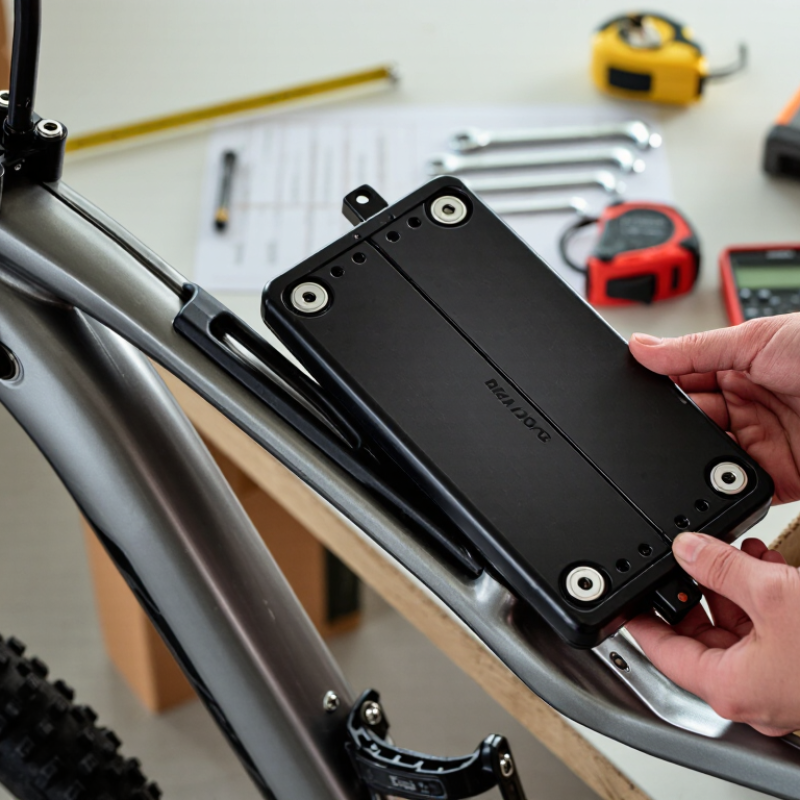
Measure the battery rail, case length, width, and mounting-hole spacing. Check the latch position carefully. A battery that slides in may still fail to lock securely.
The lower bracket should sit flat against the frame, without movement or pressure on the case. Small gaps can become serious after repeated vibration.
Do not guess.
Match the nominal voltage with the controller and display. A 36-volt system needs the correct 36-volt battery, not simply a similar-looking pack.
Inspect connector shape, pin count, polarity, and communication pins. Identical plugs can use different wiring.
A qualified technician should test polarity with proper equipment before connection. I have seen buyers focus on capacity while missing the connector pinout. That mistake is easy to make.
For international purchasing, request test documentation. IEC 62133-2 addresses rechargeable battery safety, while the UN Manual of Tests and Criteria supports transport evaluation. The IEA also notes that battery quality and safety remain important barriers to wider electric mobility adoption. Ask for the exact model drawing, charger specification, cell configuration, and mounting photos. Supplier descriptions are sometimes incomplete. Verify everything.
How to Choose a Hailong Ebike Battery for Global Buyers
Cell quality should be your first comparison point when selecting a Hailong ebike battery. Look for documented cell suppliers, consistent capacity ratings, and test results from controlled samples. A battery marked “high capacity” may still use uneven cells. That can cause faster voltage drops, reduced range, and extra heat during climbs. Ask whether the cells are new, matched, and tested before assembly. A clear answer matters. A polished label does not prove quality.
Safety features deserve equal attention. A reliable battery should include a battery management system that controls overcharge, over-discharge, short circuits, and excessive current. Temperature monitoring is valuable during summer rides or long uphill sections. Check the enclosure for secure locking, strong connectors, and protection against moisture. Certification documents should match your destination market and the exact battery model. Generic certificates can be misleading. I would verify them carefully.
Charging requirements must match your ebike system, not just the battery socket. Confirm the battery voltage, charger output, connector type, and charging current before purchase. Use the supplied charger or a verified replacement with identical specifications. Charge on a stable, non-flammable surface, away from rain and direct heat. Do not charge a cold, damaged, swollen, or unusually hot battery. Allow it to cool first. Charging overnight feels convenient, but it weakens good safety habits. Some advice online sounds confident, yet local electrical standards and transport rules may differ. Check them.
Compare common lithium-ion cell chemistries by typical specific energy and cycle life before checking pack voltage, BMS protection, charger compatibility, and local transport requirements.
NMC cells generally provide higher energy density, while LFP cells usually offer longer cycle life and better thermal stability.
Select a pack with a BMS that provides overcharge, over-discharge, over-current, short-circuit, and temperature protection.
NMC charging normally terminates at 4.20 V per cell; LFP charging normally terminates at 3.65 V per cell. Use only the charger specified for the pack chemistry and series voltage.
Values shown are representative published ranges converted to midpoint estimates: NMC specific energy 150–250 Wh/kg and cycle life 1,000–2,000 cycles; LFP specific energy 90–160 Wh/kg and cycle life 2,000–5,000 cycles. Actual results vary with cell grade, temperature, charge rate, depth of discharge, and BMS settings.
How to Choose a Hailong Ebike Battery for Global Buyers
A Hailong ebike battery needs more than the right voltage and capacity. Check whether the seller supports lithium-battery transport under UN 38.3 testing requirements. The International Energy Agency reported that global electric vehicle sales exceeded 14 million in 2023, increasing demand for safer battery logistics and documentation. Ask for the test summary, safety data sheet, packing instructions, and declared watt-hours before payment. Some sellers provide vague paperwork. That is a warning sign.
Certification requirements vary by destination. For Europe, verify applicable CE documentation and battery obligations under the EU Battery Regulation. For North America, ask whether the battery and charger have recognized electrical safety certification. Certification is not identical to quality, unfortunately. Shipping also matters. Air freight may require stricter packaging, labeling, and carrier approval than sea freight. Confirm delivery terms, customs responsibility, tracking, and procedures for damaged parcels.
Tips: Request a written warranty covering capacity loss, charging failure, and manufacturing defects. A practical warranty should state duration, test conditions, return costs, and replacement timelines. Check whether the service team can supply connectors, chargers, seals, and diagnostic guidance in your time zone. The Global E-waste Monitor 2024 reported 62 million tonnes of electronic waste in 2022, highlighting the value of repairable products and responsible battery recycling. Keep photos of the battery label and package at delivery. They may become essential evidence.
| Evaluation Dimension | Typical Data or Requirement | Why It Matters to Global Buyers | Recommended Verification |
|---|---|---|---|
| Battery Format | Hailong-style downtube battery enclosure with a slide-in rail, locking mechanism, discharge connector, and charger port. | The battery must physically match the bicycle frame, mounting rail, connector position, and controller wiring. | Confirm enclosure dimensions, rail-hole spacing, connector type, polarity, key position, and mounting hardware before ordering. |
| Nominal Voltage | Common configurations are 36 V and 48 V. A 36 V lithium-ion pack normally uses 10 series cell groups; a 48 V pack normally uses 13 series cell groups. | Voltage must be compatible with the motor controller. Using the wrong voltage can cause malfunction or permanent electrical damage. | Match the battery’s nominal voltage with the controller label and the original battery specification. |
| Capacity and Energy | Typical capacities include 10 Ah, 13 Ah, 15 Ah, 17.5 Ah, and 20 Ah. Energy is calculated as nominal voltage × ampere-hours; for example, 48 V × 15 Ah = 720 Wh. | Higher watt-hours generally provide longer potential range but may increase weight, cost, and transport restrictions. | Request rated voltage, rated capacity, watt-hours, cell configuration, and a capacity test method. |
| Battery Chemistry | Most compact ebike batteries use rechargeable lithium-ion cells, commonly based on nickel-manganese-cobalt chemistry. Lithium iron phosphate is another option but is usually larger and heavier for the same nominal energy. | Chemistry affects energy density, weight, operating temperature, service life, and enclosure size. | Obtain the chemistry, cell model, production date, and safety data from the supplier. |
| Battery Management System | A suitable BMS should provide overcharge, over-discharge, over-current, short-circuit, and temperature protection. Some designs also provide cell balancing. | The BMS is a primary safety and reliability component and must support the controller’s current demand. | Ask for continuous discharge current, peak current, low-temperature charging protection, and BMS test records. |
| Air-Transport Classification | Standalone lithium-ion batteries are regulated as dangerous goods. Batteries over 100 Wh commonly face stricter cargo-aircraft, packaging, labeling, and documentation requirements. | A battery may be technically shippable but unavailable through ordinary passenger-aircraft or express-parcel services. | Confirm the battery watt-hours, UN number, transport mode, carrier acceptance, and current IATA requirements. |
| Sea and Ground Shipping | Sea freight is generally handled under the International Maritime Dangerous Goods framework. Road and rail shipments follow the applicable national or regional dangerous-goods rules. | Sea or specialized ground transport can be more practical than air transport for batteries above common parcel limits. | Request the shipping method, dangerous-goods declaration, packaging specification, and destination import requirements in writing. |
| UN 38.3 Testing | Lithium cells and batteries offered for transport should have passed the applicable UN Manual of Tests and Criteria, Part III, Subsection 38.3 tests. | Transport providers and customs authorities may require evidence that the battery design has passed transport-safety testing. | Request a current UN 38.3 test summary that identifies the exact battery model and revision. |
| Product Safety Standards | IEC 62133-2 is widely used for portable sealed secondary lithium cells and batteries. UL 2271 is a recognized North American standard for batteries used in light electric vehicles. | The relevant standard depends on the destination market, product category, and buyer’s compliance obligations. | Verify certificate scope, test report number, laboratory accreditation, battery model, and validity with the issuing body where possible. |
| Regional Market Compliance | European sales may involve CE conformity obligations and applicable battery, EMC, RoHS, and product-safety requirements. Other markets may require local electrical, transport, recycling, or labeling compliance. | Compliance responsibility can fall on the manufacturer, importer, distributor, or seller depending on the jurisdiction. | Identify the importer of record and obtain a destination-specific compliance checklist before purchase. |
| Charger Compatibility | A 36 V lithium-ion pack normally requires a charger with an output of approximately 42.0 V. A 48 V lithium-ion pack normally requires a charger with an output of approximately 54.6 V. | The wrong charger voltage or connector polarity can create a serious safety hazard. | Confirm charger output voltage, current, plug dimensions, polarity, input-voltage range, and local plug compliance. |
| Operating Conditions | Performance is affected by temperature, rider weight, tire pressure, terrain, assist level, wind, and battery age. Charging a lithium-ion battery below 0°C can damage cells unless the BMS and design specifically support it. | A stated range is not a guaranteed distance and may vary substantially between countries and riding conditions. | Request test conditions, recommended charging temperatures, storage limits, and a realistic range estimate. |
| Warranty Coverage | Commercial warranties commonly range from 12 to 24 months, subject to documented terms. Capacity-retention promises may use a threshold such as 70% to 80% of rated capacity after a stated period or cycle count. | Warranty duration alone does not show how defects, shipping damage, capacity loss, or misuse will be handled. | Check start date, exclusions, cycle limits, capacity threshold, claim evidence, return address, and freight responsibility. |
| After-Sales Support | Useful support includes wiring diagrams, installation instructions, diagnostic procedures, spare keys, replacement connectors, BMS troubleshooting, and documented response times. | Battery faults may require technical diagnosis rather than immediate replacement, especially when international returns are expensive. | Ask whether remote diagnosis, replacement parts, repair, local service, and multilingual support are available. |
| Packaging and Arrival Inspection | Packaging should prevent movement, terminal contact, impact, moisture exposure, and accidental activation. The outer package should carry the applicable lithium-battery handling marks and labels. | Visible damage, swelling, leakage, odor, abnormal heat, or a damaged connector can indicate a safety risk. | Photograph the package before opening, record the battery serial number, and do not charge a visibly damaged battery. |
| Total Landed Cost | Calculate product price, charger, packaging, dangerous-goods surcharge, freight, insurance, customs duty, VAT or sales tax, brokerage, and possible recycling fees. | The lowest product price may not result in the lowest delivered cost or the best warranty outcome. | Obtain a destination-specific quotation showing Incoterms, taxes, insurance, delivery time, and responsibility for customs clearance. |
Note: Shipping rules, product-safety obligations, and warranty rights vary by destination, battery watt-hours, transport mode, and seller status. Confirm the current requirements with the carrier, customs authority, and relevant conformity-assessment body before shipment.